The first emerald ash borer ever found in Connecticut turned up in Prospect in 2012. My town. CT DEEP confirmed it, Connecticut became the 16th state with the beetle, and it has since spread to every county in the state.
I'm Chris Jackson. I run MacKenzie Tree out of Prospect, named after my daughter MacKenzie Elizabeth, and I've been reading this town's trees since 2010, two years before the ash borer showed up anywhere in Connecticut. I've watched it work through our ash trees ever since. If you have a mature ash in your yard, this post is for you first.
Here's what the borer looks like on your tree, how the scratch test tells you dead from stressed on any species, what plain drought stress looks like, and which symptoms mean call this week versus watch until spring.
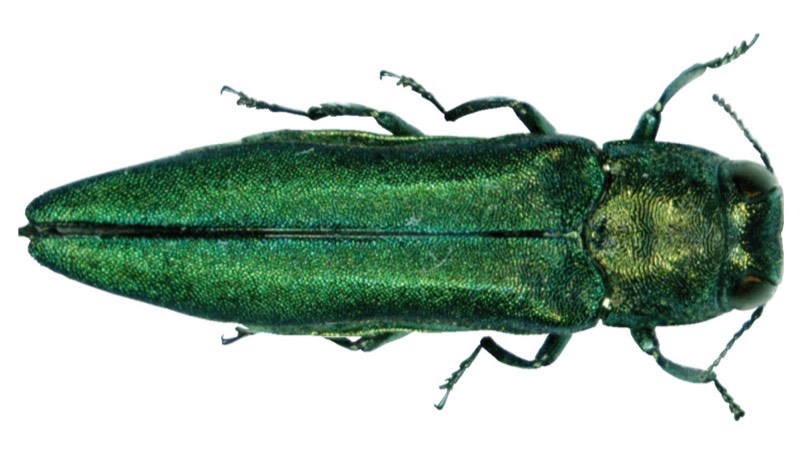
What Does Emerald Ash Borer Look Like in Connecticut?
EAB only attacks ash. The Connecticut Agricultural Experiment Station tracks its spread.
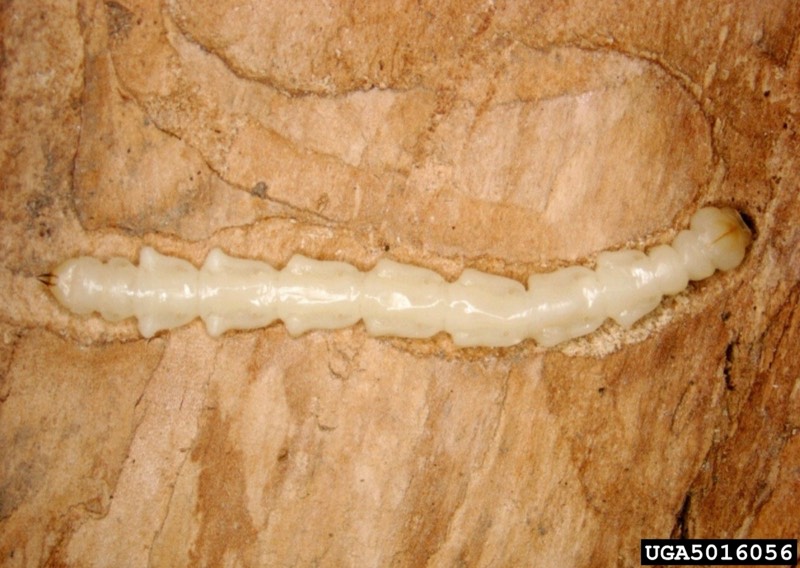
Connecticut has three native ash species, white, green, and black, and if you have a mature ash you should assume the beetle has found it or will. CT DEEP puts the timeline bluntly: once infested, death typically follows within 2 to 3 years.
Here's what I look for, in the order you'll notice from the ground:
- Thinning at the top. EAB kills from the crown down. The upper third goes sparse, then bare, while the lower canopy still looks passable.
- Woodpecker blonding. Woodpeckers strip outer bark to reach larvae, leaving pale patches visible from across the yard. Heavy blonding on an ash is close to a diagnosis by itself.
- Epicormic shoots. Bushy sprouts erupting from the trunk, especially low. That's a stressed tree throwing a last-ditch effort below the damage.
- Bark splits. Vertical cracks over the larval feeding areas, sometimes with sunken or sloughing bark around them.
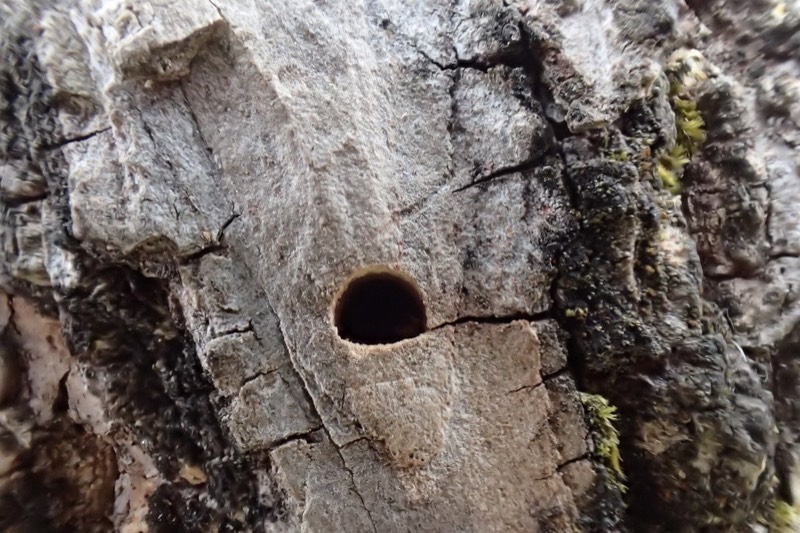
- D-shaped exit holes. Small, flat-bottomed holes where adult beetles emerged. Subtle, and per the CTPA easy to misread, so I treat them as confirmation rather than the first clue.
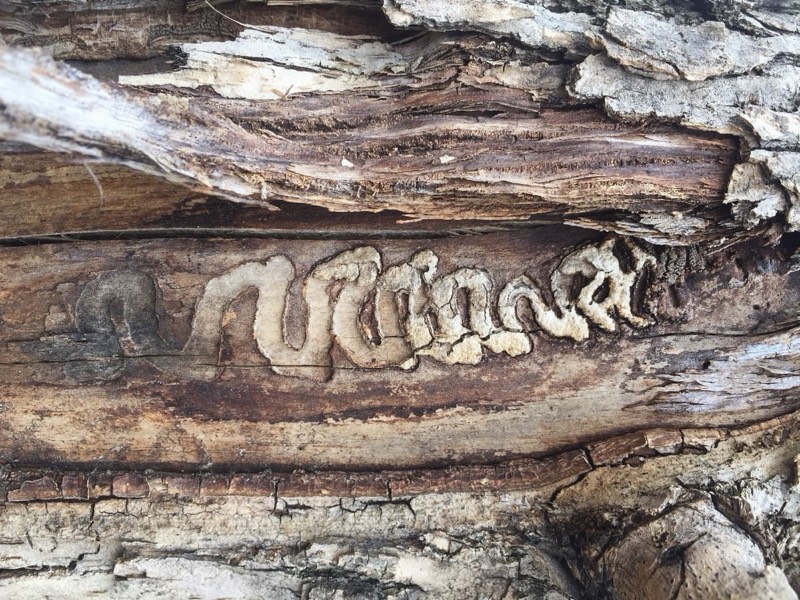
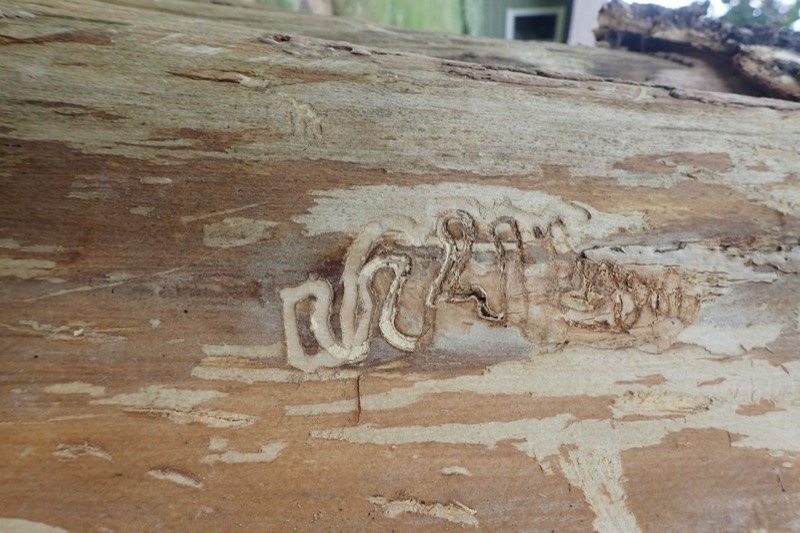
- S-shaped galleries. Peel bark off a dead limb and you'll see winding, serpentine tunnels packed with sawdust-like frass. On ash, that pattern is EAB, full stop.
Two things to do if you're seeing this. First, report it. The Connecticut Agricultural Experiment Station's state entomologist office takes EAB reports at 203-974-8474. Second, decide fast, because ash is the one tree where waiting actively costs you. An ash caught early, with most of its crown intact, can sometimes be protected with a systemic insecticide treatment on a recurring schedule. Ask when you call and we'll point you in the right direction, whether that's us or a treatment specialist.
Once an ash is dead, the clock runs differently. Dead ash goes brittle within a year or two, and brittle means climbers can't safely rope into it. The job usually becomes bucket or crane work, and I wrote a full piece on when a removal actually needs a crane. Dead ash near houses is the most common crane candidate in our corner of New Haven County.
Why Does Late Summer Expose Dying Trees?
Three things come to a head right now.
Drought stress peaks. By late August a tree has been pumping water since April. In a dry Connecticut summer, the shallow-rooted and the already-weak run out of margin first, and it shows in the leaves.
Borer damage becomes visible. Emerald ash borer larvae have been feeding under the bark all season, and the thinning and dead limbs they cause stand out against what a full August crown should look like.
Storm-weakened trees fail slowly. A tree that took a hit in a spring or July storm can look fine for weeks, then brown out a limb at a time as a cracked union or torn root system gives up. Fresh damage is the emergency storm damage guide's territory. This post is about the slower version.
Whatever you find now, you still have time to act before winter storms test every weak tree in the state.
Is the Tree Dead, Stressed, or Dormant? Start With the Scratch Test
The scratch test is the sixty-second answer, the same one I do on your lawn before I say anything else.
Find a twig about pencil thickness and scratch through the bark with your thumbnail or a pocket knife. Underneath is a thin layer called the cambium.
- Green and moist means that branch is alive.
- Brown, dry, and brittle means that branch is dead.
One twig doesn't decide anything, because trees die in sections. Test several spots around the tree, and if a twig comes up dead, work back down the branch and scratch again until you hit green or run out of branch. Add the snap test: live twigs bend, dead twigs snap clean and dry. And check buds. A live branch already carries next spring's buds, even in August.
Now the dormancy question, because "is my tree dead or dormant" gets asked constantly. In a Connecticut August, no deciduous tree is dormant. Dormancy is a winter state, so a bare maple or oak right now is either dead or in serious trouble. In winter the question is legitimate, and the scratch test settles it then too: green cambium in January means asleep, not gone.
The one late-summer wrinkle: a drought-stressed tree can shed green or yellow leaves early on purpose, cutting its losses to protect the roots. That tree scratches green. A dead one scratches brown. Same look from the street, different diagnosis, which is why you scratch before you worry.
What Do Summer Drought Stress Signs Look Like?
Not every rough-looking tree is dying. A dry Connecticut summer produces predictable symptoms, and UConn's Home and Garden Education Center documents them every dry year:
- Leaf scorch. Brown, crispy edges on leaves, worst on the sunny and windward sides.
- Early fall color and early leaf drop. A tree turning in August is shedding load, not celebrating autumn.
- Wilted or curled leaves that don't recover overnight.
- Undersized leaves and short new growth, a sign the stress carried over from last year.
- A thin crown overall. You can see more sky through the tree than you should.
A stressed tree scratches green. It needs help, not a chainsaw. Give it a slow, deep soak once a week when there's no rain, out at the drip line where the feeding roots are, not against the trunk. Put 2 to 3 inches of mulch over the root zone, keeping it off the bark. Skip fertilizer, which pushes growth the tree can't support.
Two cautions from the extension literature. First, drought damage lags. UConn notes that a tree stressed this year may look normal next spring and then fail in the heat of next summer. Second, drought opens the door to secondary attackers. Stressed oaks in particular invite two-lined chestnut borer and root diseases, which is how "it just needed water" becomes "it needs to come down" two seasons later.
Which Symptoms Mean Call Now, and Which Mean Watch and Wait?
This is the judgment call homeowners struggle with, so here's my honest sorting, the same one I use at free estimates.
Call this week:
- The scratch test comes up dead through major limbs or the whole crown, and the tree can reach a house, driveway, play area, or wires when it fails.
- It's a dead or mostly dead ash, anywhere near anything. Brittleness makes every month of delay a worse deal.
- Mushrooms or shelf fungus on the trunk or root flare. Fruiting bodies mean decay inside, and watering doesn't reverse it.
- A new lean, or soil lifting or cracking on one side of the base. That's root failure in progress and it belongs with the emergency guidance, not a someday list.
- Large dead limbs hanging over anything you care about, even if the rest of the tree is alive.
- A visible crack through the trunk or through a main union.
Watch, water, and recheck in spring:
- Scorched leaf edges on an otherwise full canopy.
- Early fall color or early leaf drop on a tree that scratches green.
- A thin crown with no fungus, no dieback pattern, and no target underneath.
- One small dead limb in an otherwise healthy tree. Prune it out and move on.
If you're not sure which list you're on, that's what the free look is for. My older post on signs a tree needs to be removed goes deeper on the structural red flags.
What Does Waiting on a Dead Tree Actually Cost?
People assume the removal price is the removal price whenever they schedule it. With dead trees it isn't.
A freshly dead tree still has sound wood. A climber can work it, rigging holds in it, and it comes apart on a normal schedule at a normal price. Every year it stands, the wood dries, cracks, and weakens. Eventually the tree can't be climbed at all, and the job moves from rope work to crane work. In our cost guide terms, that can be the difference between a large conventional removal at $1,400 to $2,800 and a crane-class job at $2,500 to $6,000 and up. Same tree. The only variable was time.
And that's the good outcome. The bad outcome is the tree makes the decision for you in a February nor'easter, on the house, at emergency rates, with an insurance claim attached.
The timing coin has a good side too. If the tree isn't threatening anything yet, we can slot it into the slower late fall and winter calendar, the cheapest time to buy tree work in Connecticut. Dead now, removed in December, replaced next fall. That last step is what the companion post on fall tree planting in Connecticut is for.
What Does a Dead Tree Assessment From MacKenzie Look Like?
You call (203) 395-8153 and Joy gets you on the schedule for a non-emergency look.
On site I do what this post just taught you, plus the parts that take 15 years of looking at Connecticut trees: scratch tests at height, a mallet sounding for hollow spots, a hard look at the root flare, blonding patterns on ash, borer risk on stressed oak. Then you get a straight answer in one of three flavors. It's fine, here's how to help it. It's dying, here's the realistic timeline. Or it's dead, here's the written quote, and here's whether it's a this-week problem or a this-winter problem.
No invented urgency. If a dead tree is standing in the back forty threatening nothing but firewood, I'll tell you that too.
We're fully insured, CT DEEP licensed (arborist PMBR.05388), HIC.0644017 registered, CTPA members, and we've been reading Prospect's trees since 2010, which in this town means since before the ash borer showed up anywhere in Connecticut. Free estimates, always in writing. (203) 395-8153, or the contact page.
Chris Jackson Owner and Operator, MacKenzie Tree, LLC Prospect, CT. Serving New Haven and Fairfield counties.
Frequently Asked Questions
How can I tell if my tree is dead or just stressed?
Scratch a pencil-thick twig with your thumbnail. Green, moist tissue under the bark means alive. Brown and dry means dead at that spot. Test several branches around the tree, because trees often die in sections.
Is my tree dead or dormant?
In summer, no Connecticut deciduous tree is dormant, so a bare crown in August means dead or seriously stressed. In winter, dormancy is normal and the scratch test settles it: green cambium means asleep, brown means gone.
My tree dropped its leaves in August. Is it dead?
Not necessarily. Drought-stressed trees shed leaves early to protect their roots, and many leaf out normally next spring. Do the scratch test: green under the bark means water deeply and recheck next year, brown and brittle through the crown means it's not coming back.
How do I know if my ash tree has emerald ash borer?
Look for thinning in the upper crown, pale blonded patches where woodpeckers stripped bark, bushy shoots low on the trunk, vertical bark splits, and small D-shaped exit holes. Under the bark of dead limbs, winding S-shaped tunnels confirm it.
How fast does emerald ash borer kill a tree?
CT DEEP puts it at roughly 2 to 3 years from infestation to death. Decline often isn't obvious until the tree is badly damaged, which is why ash trees seem to die suddenly.
Can an ash tree with EAB be saved?
Sometimes, if it's caught early with most of the crown still healthy. Systemic insecticide treatments applied by a licensed arborist can protect high-value ash on an ongoing schedule. Once the crown is mostly gone, treatment is off the table and removal timing becomes the whole question.
How long can a dead tree stand safely?
There's no safe number, only species and location. Dead ash goes brittle within a year or two and fails unpredictably. Dead oak holds longer but still sheds limbs. Over a house, driveway, or play area, a dead tree is a this-season decision, not a someday one.
Does a dead tree cost more to remove than a live one?
The longer it stands, the more it costs. Fresh dead wood can often be climbed and rigged normally. Old dead wood can't be trusted with a climber, which pushes the job to bucket or crane work at a meaningfully higher price.
Who do I report emerald ash borer to in Connecticut?
The Connecticut Agricultural Experiment Station's state entomologist office, at 203-974-8474 or CAES.StateEntomologist@ct.gov. Reporting helps the state track the infestation, and it costs you nothing.
Sources
- CT DEEP, Emerald Ash Borer (first CT detection in Prospect, 2012; 16th state; death within 2 to 3 years of infestation): https://portal.ct.gov/DEEP/Forestry/Forest-Protection/Emerald-Ash-Borer-EAB
- CT DEEP, Managing Emerald Ash Borer in Connecticut (landowner guidance): https://portal.ct.gov/deep/forestry/forest-protection/managing-emerald-ash-borer-in-connecticut
- Connecticut Agricultural Experiment Station, Emerald Ash Borer, Agrilus planipennis (CT ash species; biology; statewide spread): https://portal.ct.gov/CAES/Publications/Publications/Emerald-Ash-Borer-Agrilus-planipennis
- CTPA, How to Find EAB (blonding, D-shaped exit holes, galleries, epicormic shoots; CAES reporting line 203-974-8474): https://ctpa.org/how-to-find-eab/
- CTPA, Dealing With EAB (treatment vs. removal options, systemic insecticides): https://ctpa.org/dealing-with-eab/
- Emerald Ash Borer Information Network (multi-state EAB identification and reporting reference): https://www.emeraldashborer.info/
- UConn Home & Garden Education Center, Plants Stressed by Summer Heat and Drought (scorch, early leaf drop, lagging drought damage): https://homegarden.cahnr.uconn.edu/wp-content/uploads/sites/3479/2022/08/Plants-Stressed-by-Summer-Heat-and-Drought.pdf
- UConn Home & Garden Education Center, Helping Plants During the September-October Drought (delayed drought symptoms, disease susceptibility): https://homegarden.cahnr.uconn.edu/2024/10/25/fall_drought_24/
- LSU AgCenter, Still Waiting for Leaves? How To Tell if Your Tree or Shrub Is Dead, Dormant or Just Struggling (scratch test and bud check): https://www.lsuagcenter.com/articles/page1747856424360
- CT DEEP, Commercial Arborist License (license requirement and lookup): https://portal.ct.gov/DEEP/Pesticides/Arborist/Commercial-Arborist-License